-
-
Call Now +91 9833287656
Forged Fittings Manufacturer
These Forged Fittings, are commonly used to change the direction in piping, thereby changing the direction of the water flow. Our entire range of forged stainless steel fittings, forged steel pipe fittings, forged alloy steel pipe fittings, thread and socket weld, 3000 fitting are appreciated for high durability, dimensional accuracy, smooth finish, leak proof and corrosion resistant features.
Types of Forged fittings
Elbow
A pipe elbow is a forged fitting installed between two lengths of pipe or tube allowing a change of direction, usually in the 90° or 45° direction. Similar to a reducing tee, reducing elbows also exist to simultaneously change flow direction and reduce flow diameter. Street Elbows have one female end to accept pipe and another male end thread that is the same size as the pipe and can avoid the use of a pipe nipple during installation.
- From : 90° Elbow, 45° Elbow
- Type : Socket Weld (S/W) & SCREWED (SCRD) – NPT, BSP, BSPT
- Size : 1/8" NB TO 4" NB
- Class : 2000 LBS - 9000 LBS
- Standard : ANSI, ASME, BS, DIN, JIS, EN
- Specification : ASTM A182 / A105 / A350 / B564
- Dimension : ASME 16.11, MSS SP-79, 83, 95, 97, BS 3799

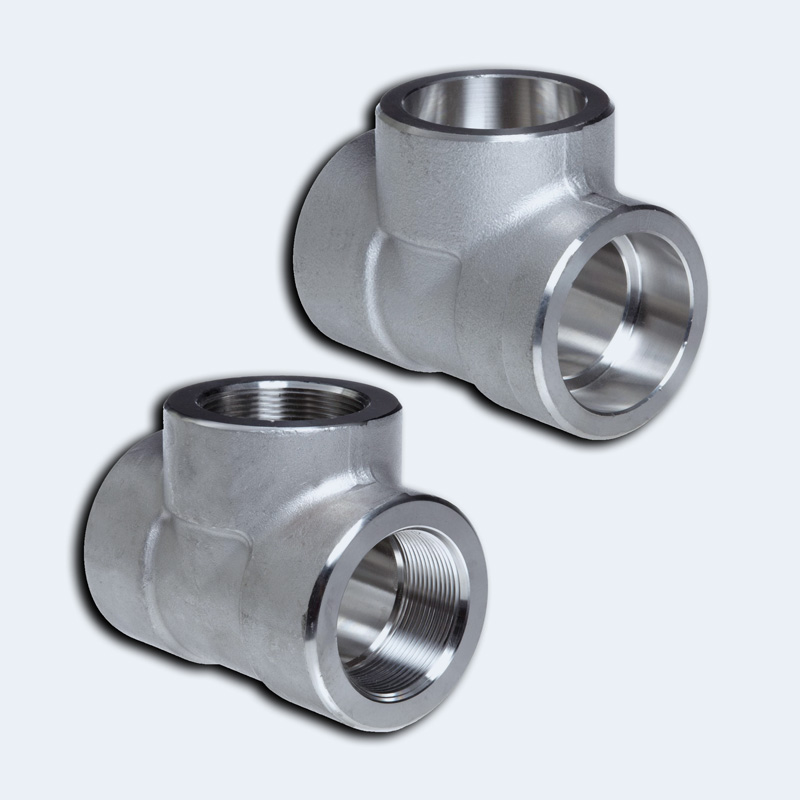
Tee
Tees are a type of forged fitting used to combine or divide process flow, and Reducing Tees additionally allow for pipe size change. The run outlets of the tee are the two in-line outlets, and the branch is the third outlet. The branch outlet is the reducing outlet in a reducing tee.
- From : Equal, Unequal, Reducing
- Type : Socket Weld (S/W) & SCREWED (SCRD) – NPT, BSP, BSPT
- Size : 1/8" NB TO 4" NB
- Class : 2000 LBS - 9000 LBS
- Standard : ANSI, ASME, BS, DIN, JIS, EN
- Specification : ASTM A182 / A105 / A350 / B564
- Dimension : ASME 16.11, MSS SP-79, 83, 95, 97, BS 3799
Coupling
Couplings are a forged fitting used to connect two lengths of pipe, and Half-coupling is screwed onto the pipe, while the other end is made to be tightly inserted, or welded, onto the other end to pipe or vessel.
- From : Full Coupling, Half Coupling, Reducing Coupling
- Type : Socket Weld (S/W) & SCREWED (SCRD) – NPT, BSP, BSPT
- Size : 1/8" NB TO 4" NB
- Class : 2000 LBS - 9000 LBS
- Standard : ANSI, ASME, BS, DIN, JIS, EN
- Specification : ASTM A182 / A105 / A350 / B564
- Dimension : ASME 16.11, MSS SP-79, 83, 95, 97, BS 3799

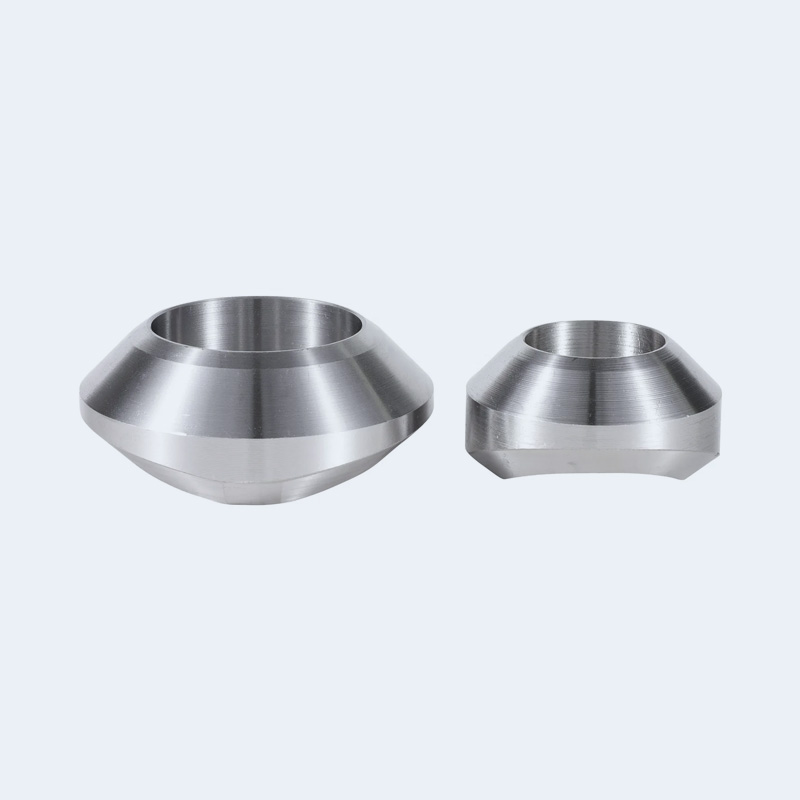
Olets
Olets (also known as Branch Connection fittings) are fittings which provide an outlet from a larger pipe to a smaller one (or one of the same size). The main pipe onto which the branch connection is welded is usually called the Run or Header size. The pipe to which the branch connection provides a channel is usually called the Branch or Outlet size.
- From : Weldolet, Threadolet, Sockolet, Elbolet, Brazolet, Nipolet, Flexolet, Latrolet, Sweepolet
- Size : 1/8" NB TO 48" NB
- Class : 2000 LBS - 9000 LBS
- Standard : ANSI, ASME, BS, DIN, JIS, EN
- Specification : ASTM A182 / A105 / A350 / B564
- Dimension : ASME 16.11, MSS SP-79, 83, 95, 97, BS 3799
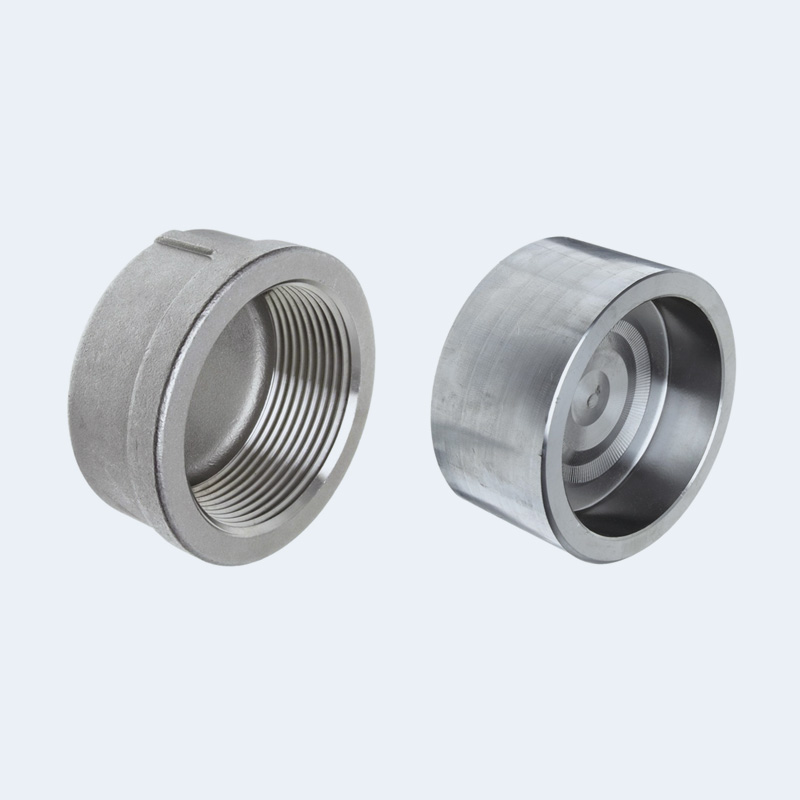
End Cap
Caps are forged steel fittings used to terminate the flow, inserting over the end of the pipe.
- From : Pipe Cap, End Cap
- Type : Socket Weld (S/W) & SCREWED (SCRD) – NPT, BSP, BSPT
- Size : 1/8" NB TO 4" NB
- Class : 2000 LBS - 9000 LBS
- Standard : ANSI, ASME, BS, DIN, JIS, EN
- Specification : ASTM A182 / A105 / A350 / B564
- Dimension : ASME 16.11, MSS SP-79, 83, 95, 97, BS 3799
Union
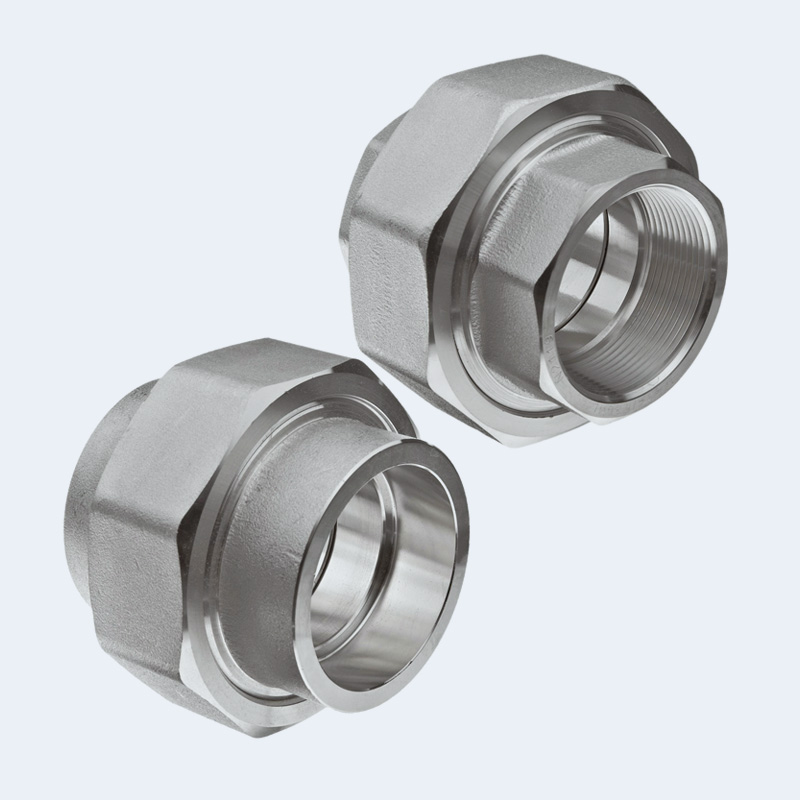
Union are a forged fitting similar to a coupling but allow a convenient disconnection and connection; it has 3 parts: a nut, a female end, and a male end. They allow two lengths of pipe to be assembled and detached without causing any deformation to the pipes.
- From : Union, Hex Union
- Type : Socket Weld (S/W) & SCREWED (SCRD) – NPT, BSP, BSPT
- Size : 1/8" NB TO 4" NB
- Class : 2000 LBS - 9000 LBS
- Standard : ANSI, ASME, BS, DIN, JIS, EN
- Specification : ASTM A182 / A105 / A350 / B564
- Dimension : ASME 16.11, MSS SP-79, 83, 95, 97, BS 3799
Manufacturing Process
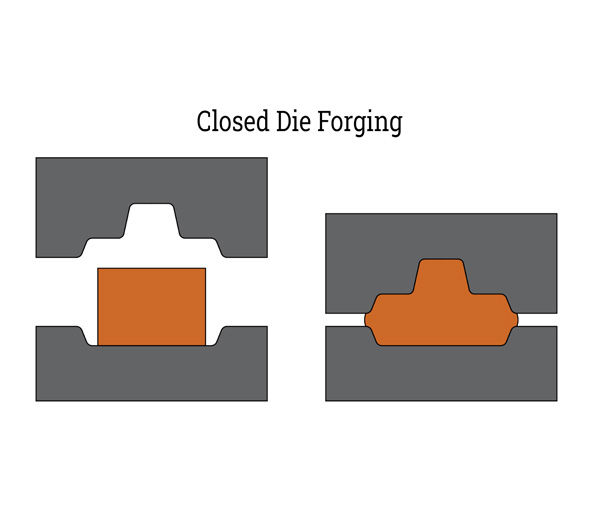
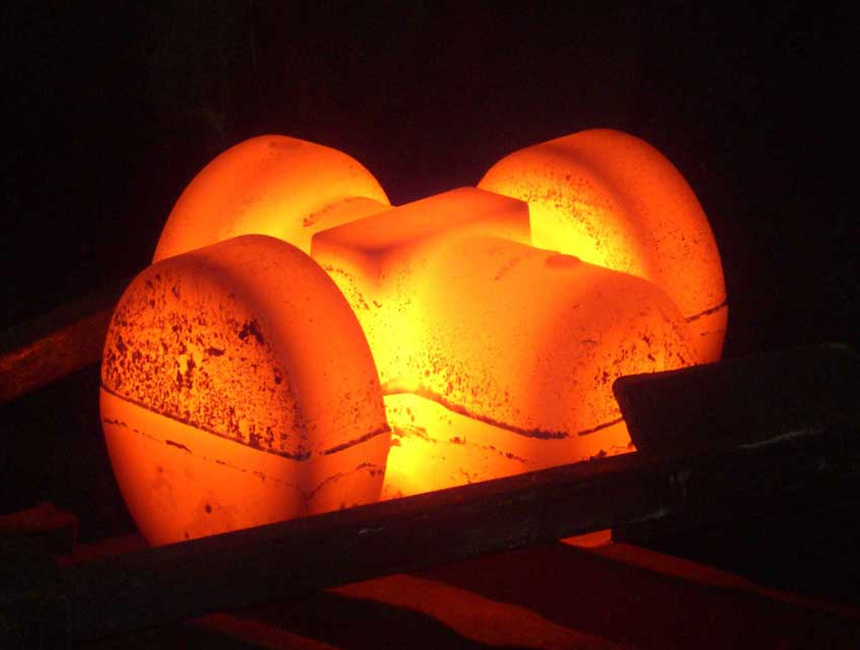
Closed die forging, also known as impression forging, is a process where two halves of a die move toward each other to enclose the workpiece or billet.
-
-
Closed die forging (also referred to as impression die forging) is a metal deformation process that uses pressure to compress a piece of metal to fill an enclosed die impression. In some closed die forging processes, a succession of impression dies are used to modify the shape of the material into the final desired shape and form. The type of material, tightness of tolerances, and need for heat treatment can determine the number of passes the product requires through the dies.
Two Equipment types used for closed die forging:
Mechanical forging presses: Manufacturers use mechanical presses for high volume product runs.
Hydraulic forging presses: These presses are useful for more complex shapes.
Drop forging: This process is economical for large runs and is often used instead of casting because of its superior internal grain structure.

we are the manufacturers in the various Materials
-
Stainless Steel
ASTM A182 304, 304L, 304H, 309, 310, 310S, 316, 316L, 317, 317L, 321, 321H, 347, 347H, 446, 904L
Heat Treatment Explore More -
Carbon Steel
ASTM A105, ASTM A350 (LF1, LF2, LF3), ASTM A694 (Gr. F42, F46, F56, F52, F60, F65, F70).
Heat Treatment Explore More -
Alloy Steel
ASTM A182 Gr. F5, F9, F11, F12, F22, F91
Heat Treatment Explore More -
Duplex & Super Duplex Steel
ASTM A182 Gr. F51, F52, F53, F54, F55, F57, F59, F60, F61, UNS S31803, S32205, S32760, S32750
Heat Treatment Explore More -
High Nickel Alloy
Nickel 200, 201, Monel 400, K500, Incoloy 800, 825, Inconel 600, 601, 625, Hastelloy C276, C22, Alloy 20, Titanium (Grade 2 & 5), Cupro-Nickel 70/30, 90/10.
Heat Treatment Explore More
We are your best source for steel Forged Fittings
Contact NowApplications


Chemical
Pharmaceutical

Oil & Gas
Petrochemical